
Soulfire Sessions! (All)
What they’re about
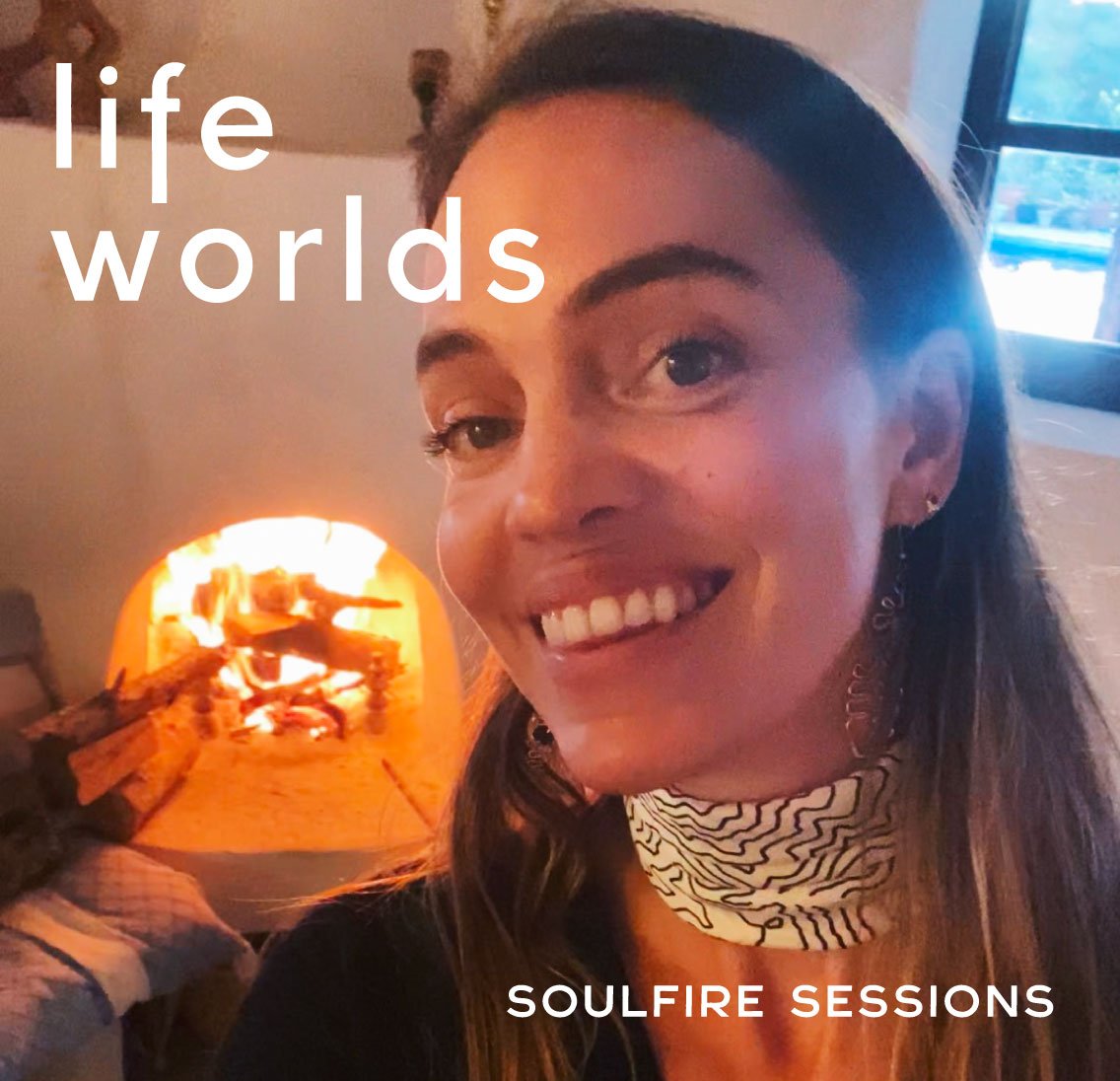
Soulfire Sessions have come to Lifeworlds! These occasional special episodes will be our take on the good old concept of a fireside chat. Intimate, philosophical, challenging, sometimes zany, always insightful, these are discussions with visionaries who don’t often get the airtime to speak about their deeper ways of being and feeling – and what lights their souls on fire.
Soulfire Sessions III: with Kensy Cooperrider
Consciousness is one of the great running threads beneath every episode of this show: a loaded term, tangled up with questions of sentience and intelligence, and carrying the most direct ethical implications for how we live on Earth.
This week I'm joined by Kensy Cooperrider, cognitive scientist and host of Many Minds podcast, circling the questions of what mind, intelligence, and experience might be beyond the human. Kensy has had hundreds of conversations with scientists working at the edges of what we know about minds, and also the most creative, concrete apertures into other lifeworlds: names, goosebumps, dreams, fire, taboos, medicine. We also discuss whether, if we're willing to stretch words like sentience across the animal kingdom, what happens when we begin to explore AI - the mineral, the silica, the metallic? Unanswerable questions, maybe, but what fun to explore.
Listen Spotify
Listen Apple Podcasts
Links:
Bio:
Kensy Cooperrider is a cognitive scientist, writer, teacher, and podcaster interested in what sets humans apart from other animals - particularly in the realms of communication, culture, and cognition. His work has ranged across finger names, Darwin's metaphors, pointing gestures, time concepts, hand mnemonics, the history of measurement, and the evolution of language, among many other topics. He is an affiliated researcher in the Department of Psychology at the University of Chicago.
Kensy serves as Associate Director of the Diverse Intelligences Summer Institute (DISI), where he focuses on content and outreach, and hosts DISI's Many Minds podcast which examines the varieties of mind and intelligence within and beyond our species. His popular writing has appeared in Aeon, Scientific American Mind, Atlas Obscura, JSTOR Daily, and The Public Domain Review, and his academic work has been published in journals including Cognition, Psychological Science, Language and Cognition, and Topics in Cognitive Science.
Quotes:
"There is culture out there everywhere — that's a really interesting first step and a crucial one. But it's not as though they're all the same. What are the interesting differences and distinctions, and where do we go from here?"
"When we extend those laudatory terms, people start to see the creatures we extend those terms to differently. 'Wait, chimpanzees have culture? Some deer, some ungulates have culture? Wow, that's amazing. These creatures are worth more of my attention, more of my empathy, more of my consideration than I thought before.'"
"But then the scientist in me is like, okay, now that we've extended that term, what is the new vocabulary we're going to use to characterize what still remains as differences — as interesting points of contrast?"
"These big constructs of language and culture are so baggage-laden. You can't talk about what is and is not language without contending with hundreds of years of scholars fighting about this, changing their definitions. So there are these slippery concepts, baggage-laden constructs, and they've just been kicking around for so long. I've found it in my own podcast, and in some of the writing I do for the podcast, to be more productive, more fun, to leave those baggage-laden constructs at the perimeter and go into something more concrete. So let's talk about names. Do animals have names?"
"What you find is that when you start digging into any of these smaller lenses — smaller peepholes into animal-human continuity — you inevitably find these fascinating commonalities and differences. I'm interested in the duality of continuity and difference that we start to see once we go down these rabbit holes and start digging into some of these little constructs."
"We have this amazing continuity across the animal kingdom, and that invites us to imagine or speculate: what do spider dreams look like? What does it mean to dream in a watery world as a dolphin?"
"It's a fascinating question: how we orient — and by 'we' I mean creatures in the broad sense — to fire. We have this substance that embodies this duality of being utterly entrancing and fascinating, and yet dangerous. So how do we react to that? How could we possibly decide that this is something worth not just approaching, but actually experimenting with?"
"The idea that there's some bright line separating this one species from all the others is just silly. That's not the way the biological world works. The biological world doesn't really create bright lines anywhere — there's just fuzziness and gradation and permutation and variance on a theme, all over the place."
"There is so much that humans have taken from the natural world — been inspired by, taken via inspiration from the natural world — and then forgotten that that's where we got it. Whether it's architecture, or string craft, or ideas about norms, or clothing, or beauty — all these things we think are just human creations. When we look at it more closely, we realize we were taking hints from the natural world."
"People who have expansionist ideas about sentience and consciousness are often actually relatively skeptical of the idea of expanding across the natural-artificial divide. In other words, these are the same people who feel strongly that we don't want to extend consciousness."
"This is sometimes called biological naturalism — the idea that there really is something special about cells and about organically evolved creatures. There's some inherent drive in those creatures that is at the root of conscious experience and the root of mind."
Soulfire Sessions II: with David McConville
David McConville is a transdisciplinary artist and researcher whoexplores how technology shapes our perspectives of Earth—from local places to our cosmic context. Our conversation examines how worldviews influence infrastructure, using Los Angeles as a case study. We explore the paradigm of "living infrastructure," discussing how David's studio Spherical collaborates with communities and organizations to develop mapping and co-design tools. Even if you’re not in LA, this episode offers valuable insights into how communities can work together to create resilient infrastructure systems that honor their unique cultural needs and local environments.
Listen Spotify
Listen Apple Podcasts
Links:
David McConville : When Utopia is Oblivion
Bio:
David McConville is co-founder and lead cosmographer of Spherical, a strategic design and integrative research studio based in xučyun / Oakland, CA. His PhD in Art and Media from Plymouth University examined how cosmological perspectives shape cultural imaginaries and ecological practices.
Soulfire Sessions I: with Daniel Schmachtenberger
In this first session I speak with my dear friend Daniel Schmachtenberger, a social philosopher and founding director of the Civilisation Research Institute. Daniel has a particular interest in the topics of catastrophic and existential risk, artificial intelligence, civilization and institutional decay and collapse as well as progress, collective action problems, social organization theories, and the relevant domains in philosophy and science.
With the fire roaring, we delve into the psychological and metaphysical underpinnings of the metacrisis, traversing topics such as fragmented consciousness, Daoism, wholeness, feeling in service to thinking, dharma enquiries, conflict theory, and what it might mean to live a meaningful life.
Listen Spotify
Listen Apple Podcasts
Links:

![[Full Length] Unexpected Agricultures — with Lyla June Johnston](https://images.squarespace-cdn.com/content/v1/61e5960411275129ba0c607d/1658128435444-KBCFLKI45Y754WXVUYCZ/Agriculture-Lyla.jpg)
![[Full Length] Unexpected Agricultures — with Michael Ableman](https://images.squarespace-cdn.com/content/v1/61e5960411275129ba0c607d/1658129338344-U3GK0WTQJL9YQU1DIPVK/Agriculture-Michael.jpg)