
“The Amazon is fluid. We couldn't just develop a simple grid as people typically would, walking a path and expecting to happen upon the bees. No… We had to completely reshift that and first see the world through the eyes of the beekeepers.”
- Dr. Rosa Vasquez Espinosa
SYNOPSIS:
What if one of the most powerful tools for saving the Amazon rain-forest was a bee most people have never heard of?
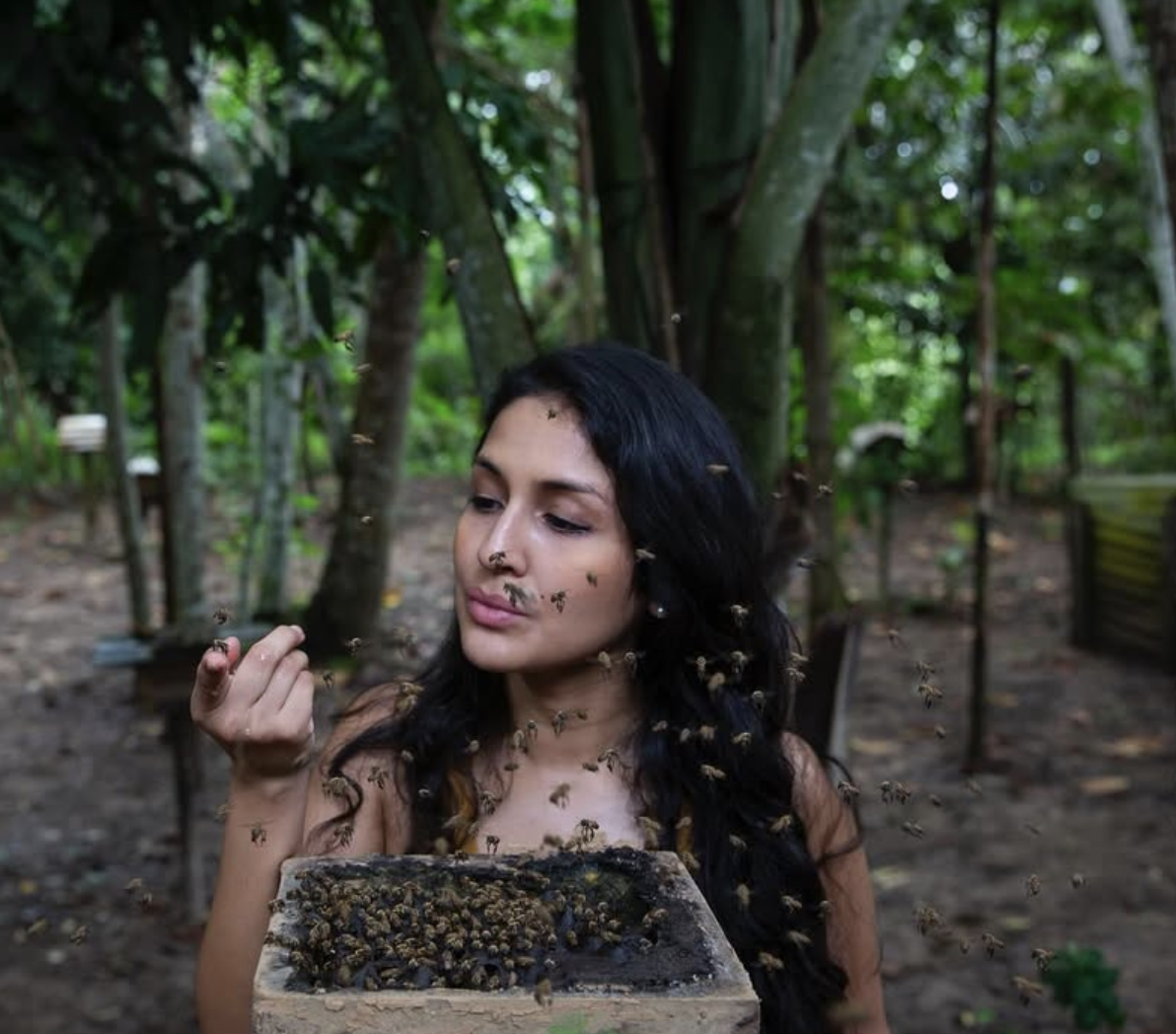
Enter the stingless bee – a 65 million year old resident of Earth that produces honeys teeming with medicinal molecules and has co-evolved with indigenous Amazonian communities across millennia. Today, these bees are at the keystone species at the heart of a pioneering conservation movement spanning science, law, economics and Indigenous rights: one that recently secured the world's first legal recognition of the rights of an insect.
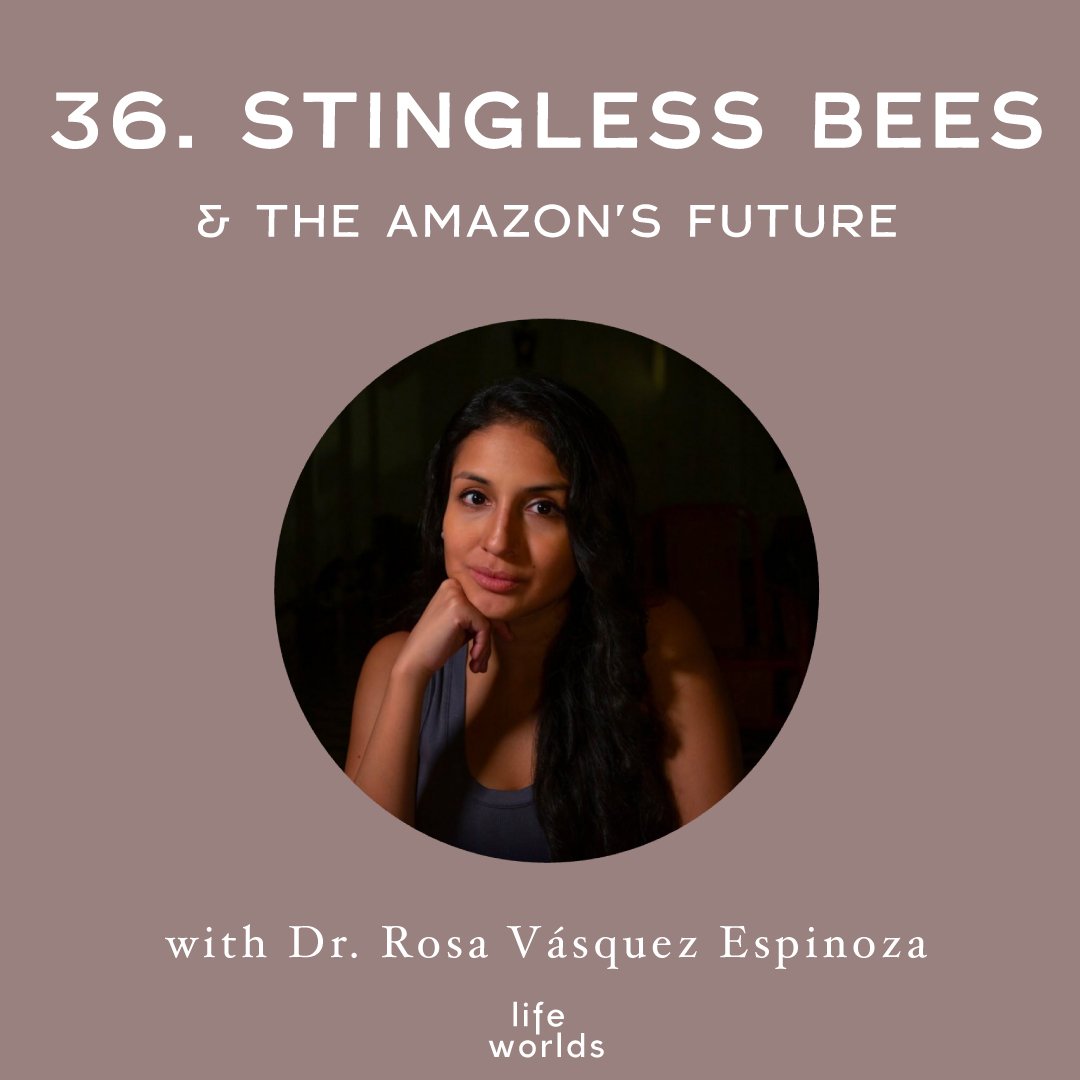
Dr. Rosa Vásquez Espinoza is the National Geographic Explorer and conservation scientist whose NGO Amazon Research Internacional is spearheading these initiatives. In this episode we explore the life world of the bees themselves, the pioneering science and bio-economies emerging around their extraordinary honey, the deep co-evolutionary bond between stingless bees and Amazonian communities, and how bridging indigenous and Western knowledge is proving essential for the forest, for the communities who steward the bees and the legal frameworks being built to protect them.
GUEST BIO:
Dr. Rosa Vásquez Espinoza is a Ph.D. chemical biologist, conservation leader and National Geographic Explorer leading the global movement protecting wild pollinators and the Amazon. Raised between the Peruvian Andes and the rainforest, she bridges cutting-edge science with ancestral knowledge to drive real-world environmental change.
Her work has achieved the world’s first legal recognition of an insect’s rights, inspired national and local conservation laws, increased the value of native honey by over 500%, and helped launch new models for positive nature-based economies across Indigenous territories.
Rosa is the Founder and Executive Director of Amazon Research Internacional, working across the Amazon basin to protect biodiversity, empower communities and build climate resilience. Her leadership has been recognised by BBC’s 100 Most Influential Women (2024), the UNESCO–Al Fozan Prize for Young Scientists, Peru’s Order of Merit - the nation’s highest civilian honour, and the New Explorer Award from The Explorers Club (2025).
Her work has been featured by The New York Times, The Guardian, BBC, CNN, CBS News, National Geographic and People Magazine, and she has appeared in major international documentary projects with the BBC, ARTE, Discovery Channel, National Geographic and Disney. She has collaborated with global brands and institutions including NASA, Boeing, PepsiCo, Garnier, and Sea-Doo, and has delivered keynote addresses and panel discussions across the UK (including University of Oxford and TEDx London Global Idea Search 2025), USA, Germany, France, Spain, Greece, Egypt, Saudi Arabia, UAE, Peru and Colombia.
Rosa’s passion for exploration and conservation is reflected in her new book, “The Spirit of the Rainforest” (2025), which takes readers on an immersive journey through the Amazon, weaving together adventure, science, and the deep-rooted wisdom of indigenous cultures.
QUOTES:
They come in so many different sizes than a typical bee, so they are so much more versatile. And because they are so ancestral, they’ve developed their genetics and behaviors co-evolving with plants around the Amazon.
The bees signify ancestry, sacredness and guidance. They are kind of like our teachers. For many of the human relatives, their entire worldview is based on the bees. And so if they disappear, that glass shatters.
The Amazon is fluid. We couldn't just develop a simple grid as people typically would, walking a path and expecting to happen upon the bees. No… We had to completely reshift that and first see the world through the eyes of the beekeepers.
We learned that indigenous people had their own taxonomy (I'm going to call it indigenous taxonomy) where they could distinguish between species by the little door entry that the bees make to their hives.
Just by spending a little bit of time with stingless bees, people end up talking a little more humanistically about them, asking, what does the bee need? You recognize they are more than just an insect. There is something much deeper. This is a companion. This is a relative.
Talking about ecology without economy is a utopian world that doesn't exist. And talking about science that accumulates amazing papers but doesn't translate into anything else - I think that is a disservice.
A key aspect was having additional protections - for us, that was the rights of nature and biocultural protocols. How can we help connect larger economic markets to local communities in a way that redistributes power, where they also have a seat at the table?
It became so critical to understand that there is a unique power in mixing these knowledge systems. Some will respond to modern scientific data, some to indigenous knowledge, and some to both. But I think we do a disservice by only presenting one or the other.
Local laws approved at the end of last year recognize not just stingless bees as the native species of Peru, but as beings inherent of rights, and their ecosystems as well. The right to be regenerated, to have access to healthy flora, to be free of pesticides, to be associated with fair trade. And for the indigenous communities that keep them to be recognized as their guardians, with the power to defend them in court if need be.
I had this whole other maternal and medicinal and spiritual relationship — and not just me, but my mom, and my grandmother, and generations before them — where the territory is life, and you develop this other sense of being with it.
LINKS:
Nat Geo: Stingless bees make ‘miracle liquid.’
Guardian: Stingless bees from the Amazon granted legal rights in world first
YOU MAY ALSO LIKE

![[Full Length] Unexpected Agricultures — with Lyla June Johnston](https://images.squarespace-cdn.com/content/v1/61e5960411275129ba0c607d/1658128435444-KBCFLKI45Y754WXVUYCZ/Agriculture-Lyla.jpg)
![[Full Length] Unexpected Agricultures — with Michael Ableman](https://images.squarespace-cdn.com/content/v1/61e5960411275129ba0c607d/1658129338344-U3GK0WTQJL9YQU1DIPVK/Agriculture-Michael.jpg)