
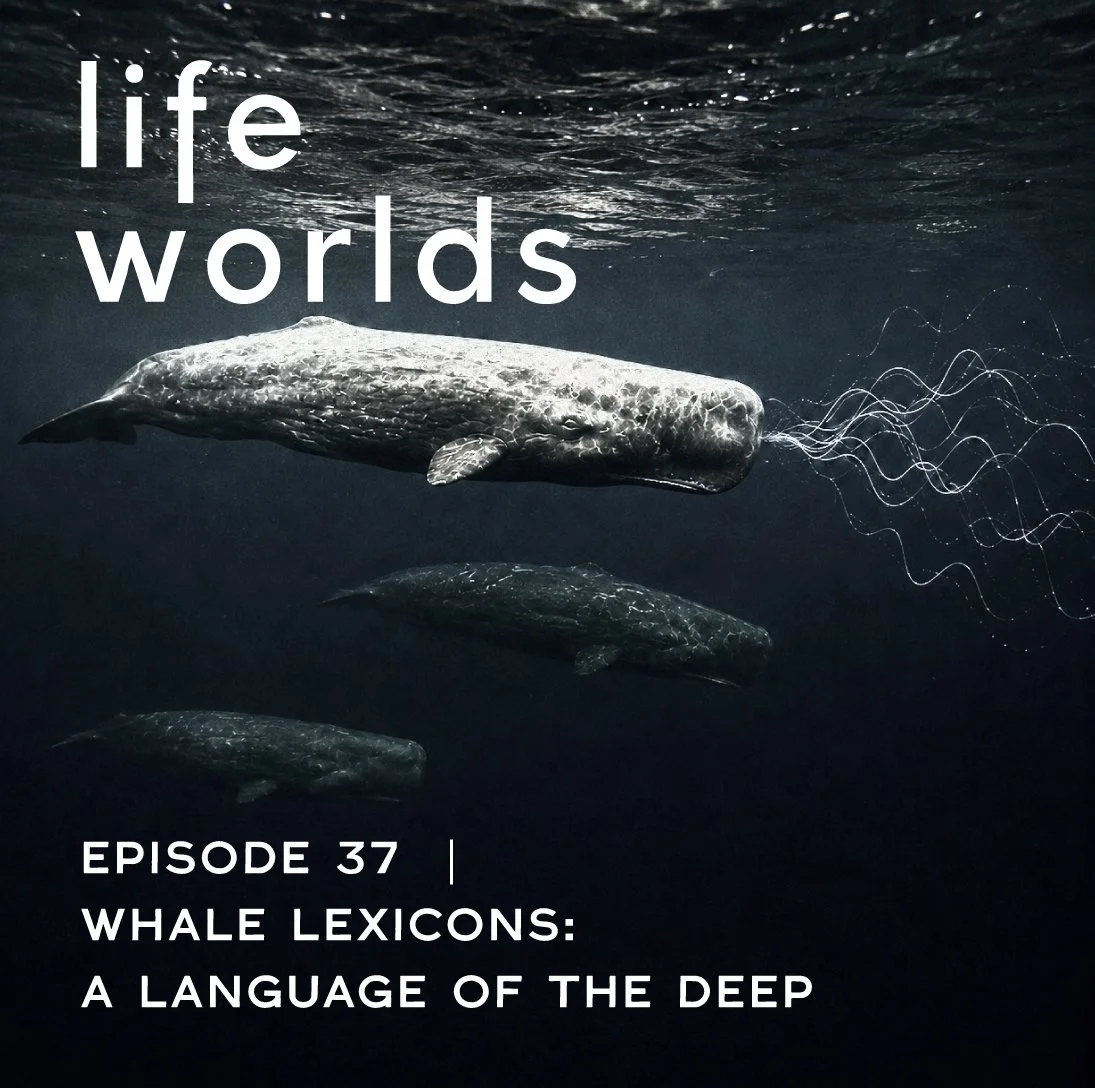
37. Whale Lexicons: A Language of the Deep — with David Gruber and César Rodríguez-Garavito
“That is, to me and to anyone who's paying close attention, evidence of cultural life - of highly synchronized social interactions that amount to deeply wise and sophisticated ways of being in community that need to be protected by the legal field.”
- César Rodríguez-Garavito
SYNOPSIS:
What does it actually mean to translate a language that has never been written down or spoken in air, whose holders are ancient ocean denizens, and may not even carry concepts we'd recognize as our own? That's the question sitting at the center of this episode, and those answering it have formed one of the more radical partnerships in science today: Project CETI and MOTH. CETI is a collective of fifty-plus scientists attempting to listen to and translate the communication of sperm whales, the largest-brained creatures on Earth. MOTH is a legal collective working to bring that science before courts, in the hope that whales might be granted something like legal standing and rights. In a barn in the English countryside, David Gruber and César Rodríguez-Garavito walk us through what it takes to listen this closely to another species, and whether this new convergence of human, animal, and machine intelligence could spark a watershed moment for conservation and consciousness.
What we'll cover:
The sperm whale's anatomy of perception, acoustic vision, and what it's like to navigate a world of inky darkness through sound
The deep evolutionary kinship between humans and whales, and what their convergent vowel-like sounds suggest about the origins of language
How Project CETI uses machine learning to find phonetic structure and contextual meaning in whale codas
The legal arguments emerging from this research, from the right not to suffer to the right to a cultural life
A remarkable multi-whale birth event — and what it reveals about coordination, kinship, and social roles among whales
The ethical guardrails (NACT) proposed for AI-assisted animal communication technology, and the risks of getting this wrong
Whether this new convergence of human, animal, and machine intelligence could spark a watershed moment for conservation and consciousness
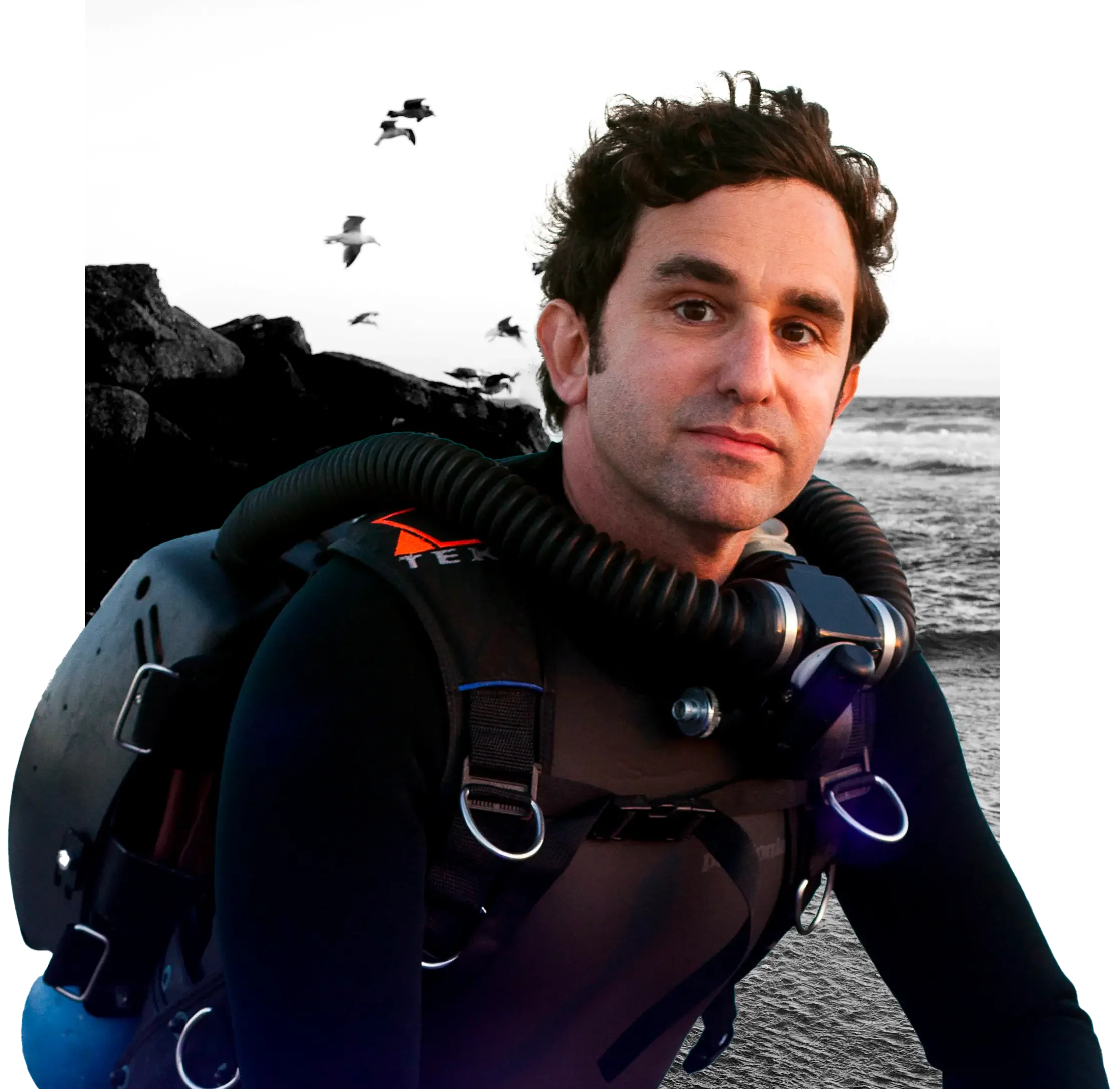
GUEST BIO:
David Gruber is the Founder & CEO of Project CETI (Cetacean Translation Initiative), an interdisciplinary scientific initiative and nonprofit organization applying advanced machine learning and robotics to translate the communication of sperm whales. His team has made landmark discoveries including the identification of the sperm whale phonetic alphabet, vowel- and diphthong-like features in sperm whale codas, and evidence of cooperative care during a birthing event. His team is also responsible for the development of the first translative models for whale communication. Current initiatives include a partnership with the More-Than-Human (MOTH) Program at NYU School of Law to assist in the development of ethical and legal frameworks for AI-assisted animal communication, alongside efforts to advance the scientific understanding of non-human communication. A National Geographic Explorer and Distinguished Professor at the City University of New York, Gruber's research spans three decades of deep-ocean science, including the discovery of over 200 biofluorescent species and the development of "gentle" robotics to interact with marine life in collaboration with the Harvard Microrobotics Laboratory.
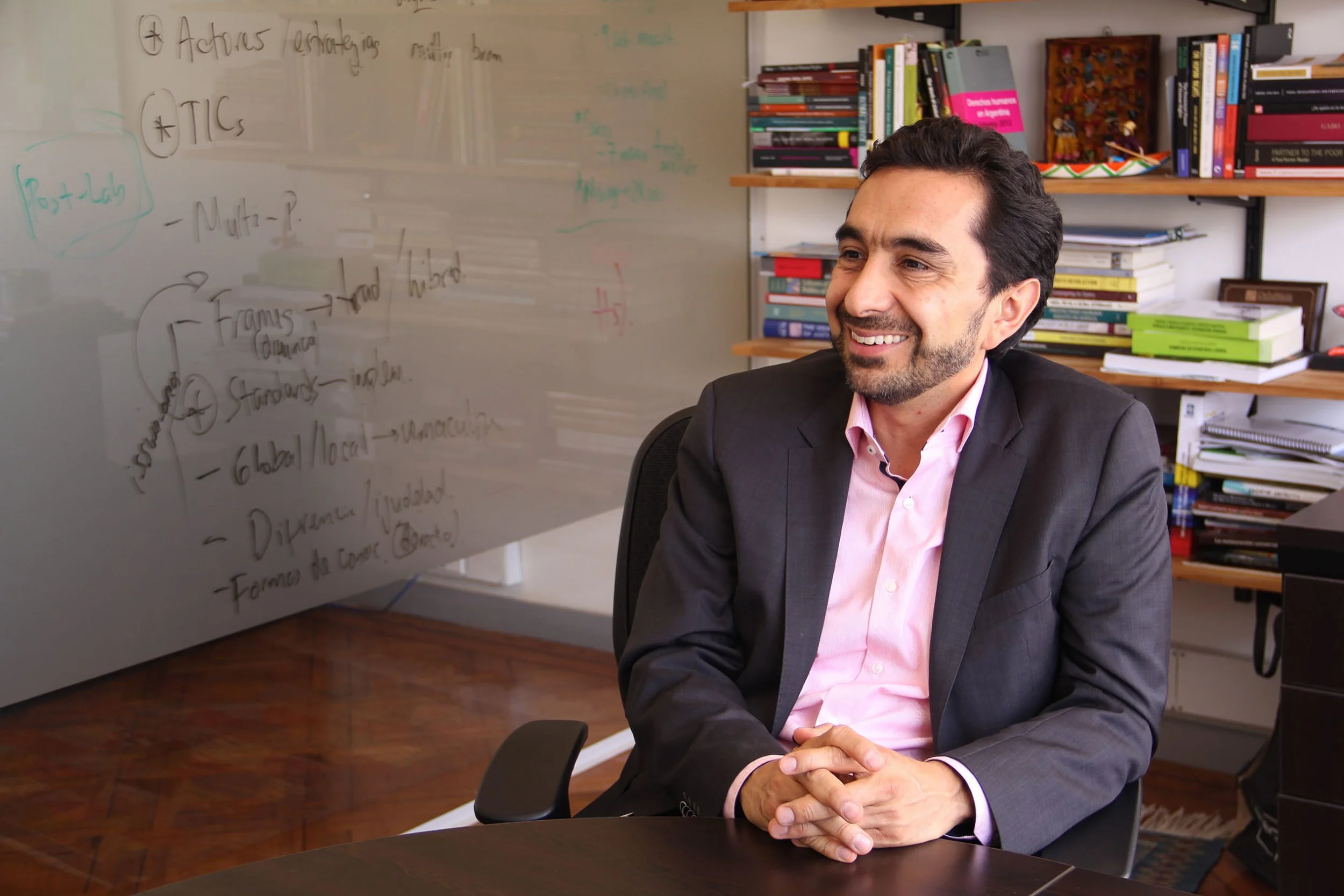
César Rodríguez-Garavito is an Earth rights scholar, field lawyer, and founding director of the MOTH (More-Than-Human Life) Program at NYU School of Law, a leading global initiative advancing rights and well-being for humans, nonhumans, and the web of life that sustains us all. He is a Professor of Law and Director of the Earth Rights Research & Action (TERRA) Clinic at NYU. César’s work has advanced new ideas and legal actions worldwide on issues such as climate justice, Indigenous rights, and what he proposes to call “more-than-human rights” (rights of nature). His ongoing initiatives include a pioneering ethical and legal framework for AI-assisted animal communication studies, a partnership with Project CETI on the legal implications of AI-assisted whale language translation, collaborations with Indigenous leaders and communities of the Amazon and Pacific Island nations to protect forest and ocean beings, and work with the Society for the Protection of Underground Networks on legal pathways to protect the fungal kingdom of life.
QUOTES:
David Gruber
Even for groups of whales that are living in the same area, their clan is important — which group they're with. So they could be sharing similar space, but you could tell which clan they're from just on discrete little changes in their voices.
Some of the machine learning techniques involve looking for patterns in almost 300 dimensions.
The beautiful part about this work is that it forces me and the members of the CETI team to constantly think about what it is like to be a whale.
It's something to maybe think of as “acoustic vision” — being able to process echoes in a similar way that your eyeball might be working.
We do have a common ancestor with whales at 92 million years ago. So we are mammals and they're another placental mammal. We were connected, but a long time ago. And I like to feel like it's so beautiful that there were these parallel journeys. All life came from the ocean and came onto land.
The phonological elements of how humans speak in terms of vowels and consonants — we're seeing an independent evolution of the core features of human language in whales. But the sound doesn't come out of their mouth. It comes out of the top of their head.
We're even getting to the level of seeing signatures in the whale voices even when a ship's around.
Eleven female whales are working, and we know there's a grandmother, the mother, and the mother's daughter there. They've worked continuously taking turns, kin and non-kin working in dyads to lift the baby out of the water. The reason they were doing this is that the babies are negatively buoyant. This collective care and working across kinship lines.
For a field where this new technology could bring us closer, if this is led by folks that really don't have expertise in animals, and they're doing it for shock value and acclaim, and not even publishing according to the peer review of science, it could be dangerous.
César Rodríguez-Garavito
These deep sea creatures are so complex in their communications, so alive in their cultural interactions, and so massively underestimated by human beings — despite their magnitude and despite their wisdom.
If you look back at how scientists used to define intelligence, it was all about having a brain. But then you see fungi solving all kinds of problems in a decentralized way — well, surely that's a form of intelligence and problem-solving. So science is not monolithic. It's not static. And if one does history of science, one sees how this changes — and this makes me optimistic.
Sperm whales and other whales are highly auditory animals. Their lives, their physical and social wellbeing, depend on being able to hear each other.
Our argument — and I stand behind this fully — is that the law needs to change. Biodiversity law, marine protection law, human rights and animal rights law need to be updated in light of the findings that show us that whales are suffering deeply from the incessant ship noise and traffic, and the offshore oil drilling and plans for deep sea mining — that those are forms of torture that violate fundamental rights.
So what I want to do in the legal field is start with the core rights — the ones that seem to be the more flagrant violations of fundamental principles and values — and then work from there. And eventually, but not too far into the future, make arguments like the one we make in the paper that we co-published on the implications for the legal field of CETI's research: that whales have a right to cultural life.
That is, to me and to anyone who's paying close attention, evidence of cultural life — of highly synchronized social interactions that amount to deeply wise and sophisticated ways of being in community that need to be protected also by the legal field.
By individuals taking turns in a very synchronized way, they were essentially playing social roles. And that is proof against the view that animal rights don't make any sense because supposedly animals don't have any social responsibilities. One of the arguments made against animal rights is that if animals have rights, they should also fulfill responsibilities.
LINKS:
Time: Researchers are Using AI to Understand what Animals are Saying
Lifeworlds Episode: The Sounds of Life: Bioacoustics, A.I. and Ethics – with Karen Bakker
YOU MAY ALSO LIKE

![[Full Length] Unexpected Agricultures — with Lyla June Johnston](https://images.squarespace-cdn.com/content/v1/61e5960411275129ba0c607d/1658128435444-KBCFLKI45Y754WXVUYCZ/Agriculture-Lyla.jpg)
![[Full Length] Unexpected Agricultures — with Michael Ableman](https://images.squarespace-cdn.com/content/v1/61e5960411275129ba0c607d/1658129338344-U3GK0WTQJL9YQU1DIPVK/Agriculture-Michael.jpg)